
Building the builders – ATB Financial
- Published On
- November 19, 2026
A conversation with Carla MAdra, President & CEO of Women Building Futures
By Carol Kamel, Economic Analyst at ATB Financial
Key points
- Expanding women’s participation in the skilled trades is essential to meeting upcoming construction and infrastructure demand.
- Setting women up to succeed in the trades requires multifaceted support, from childcare and financial stability to properly fitting protective gear and inclusive job sites.
- Beyond economic independence, careers in the trades open doors to areas like project management, safety leadership, and entrepreneurship.
In our recent series Who’s going to build? (Part 1, Part 2), we explore a critical challenge facing Alberta. As major energy, infrastructure, and housing projects ramp up, will an aging workforce and slower population growth leave the province short on the skilled tradespeople needed to deliver them?
To mark Women’s Entrepreneurship Day (November 19), I sat down with Carla Madra, President and CEO of Women Building Futures (WBF), to discuss how bringing more women into the trades is transforming individual lives while helping address the looming labour shortage.
Getting women ready for the trades—and the trades ready for women
After two decades as a Chartered Professional Accountant in professional services, Carla joined WBF just over a year ago, drawn to its mission of giving women “an opportunity to build economic prosperity for their futures and communities.” Founded in 1998, WBF tackles raising female participation in the trades through both sides of the workforce equation—especially critical in a province where apprenticeship registrations have risen, yet certification completions remain low:
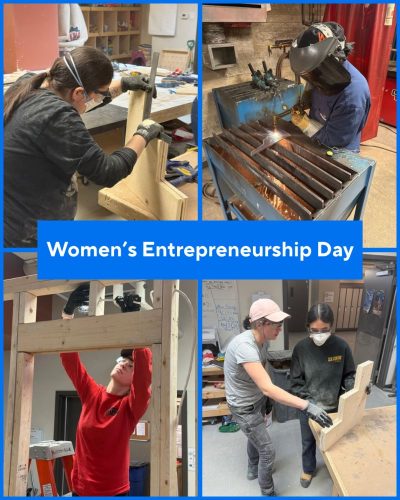
- Preparing students: Before picking up a tool, WBF candidates undergo a robust admissions process ensuring they have reliable childcare, transportation, housing, a sustainable budget, and fit-for-work clearance. Training then includes math upgrading, workplace expectations, receiving and responding to feedback, handling difficult conversations, up to eight safety tickets, thrice-weekly fitness sessions, resume writing, and both interview and hands-on workshops across five trades. WBF’s Student Impact Fund also helps ensure students have the financial support required to meet their basic needs while in the program, as well as purchase starter tools and personal protective equipment as needed.
- Preparing job sites and equipment: According to Carla, large operators are highly motivated to diversify their talent pools. When labour shortages create bottlenecks and delay projects, it is the operators who foot the bill in their capital projects and maintenance work. As a result, they are increasingly leveraging their procurement power to push for diverse hiring. However, Carla also noted that, alongside implicit biases, many job sites still lack basic accommodations like private restrooms and properly fitting personal protective equipment (PPE) for women, which can create serious safety risks.
Beyond the numbers
WBF has found immense success in placing its graduates, with 85% securing employment within six months. Carla measures success in terms of the personal freedom that follows. She shared the story of one graduate who broke down in tears at a grocery store a year after completing her program and gaining employment because, for the first time, she could afford deli meat for her children’s school lunches.
“For many of us, deli meat isn’t something we think of as a luxury,” Carla said. “For her, it was the first time she didn’t feel economic scarcity and had the ability to make choices for her family.”
Building for Alberta’s future
Even before major proposals like the Pacific Link and Pathways projects reach final investment decisions, Alberta’s construction sector is tight. In part 2 of our series, we noted that specialty trade contractors faced a 4.3% job vacancy rate in Q2 2026—well above the 3.1% provincial average—while the share of construction workers aged 55 and older has climbed to 18.4%.
Carla echoes this sentiment, noting that industry insiders are acutely aware of the anticipated specialty trades shortage; it is simply a matter of when, not if, they will be affected. As Alberta continues to grow, its labour pool must expand to keep pace. This reality underscores the critical need to boost the share of women in the trades, which currently sits below 10%.
Addressing industrial and housing demand
With projects like the Meta data centre and Dow’s Path2Zero underway, trades like electrical work are already anticipating the squeeze. Because training a journey-level electrician takes four years, operators are increasingly requiring subcontractors to bring on pre-apprentice “green hats” now. Meanwhile, with Statistics Canada projecting Alberta’s population to grow 46% by 2050 and metropolitan rental vacancies near 4%, the demand for new homes will remain strong.
To meet these needs, WBF is launching its first residential construction program—offering opportunities that may be closer to home than jobs in the Industrial Heartland or Fort McMurray—alongside a faster 6-week scaffolding and insulator program. Combined with federal incentives like the $5,000 Red Seal completion bonus and expanded Employment Insurance during classroom training, these pathways incentivize program completion.
Over 28 years, WBF has helped 3,000 women enter the trades. Under its Build Together strategy, it aims to reach 10,000 women by 2040 by expanding across Alberta with stronger employer hiring commitments. For any woman considering the field, Carla compares the opportunities presented through the skilled trades similar to an engineering degree:
“It gives you a technical foundation that opens doors everywhere—whether you spend five or ten years on the tools and then move into project management, health and safety, or launch your own business. The world really is your oyster.”
On behalf of The Twenty-Four team and ATB, thank you to Carla for sharing her insights. To learn more, visit The Twenty-Two at ATB Financial website.
* Photos provided by WBF
For women interested in pursuing entrepreneurship, W by ATB is working to pair women with equitable access to capital, tailored resources, and accredited advisors. You can learn more here.
Answer to the previous trivia question: Xi Jinping became President of China on March 14, 2013.
Today’s trivia question: As of 2024, what percentage of businesses in Canada were primarily owned by women?